Title
City, Image, and the Construction
of Social Life
Tags
Spatial theory, urban production, visual representation
Type
Essay
Year
2026
The essay was published in the accompanying publication for the exhibition Wie wollen wir leben? at the Kunststiftung DZ BANK in Frankfurt am Main (3 June–3 October 2026). It reflects on the interrelation between urban space, visual representation, and social organization, and describes the city not as a given order, but as a space produced through images, practices, and modes of perception.
↘︎ Download the publication (DE)

The city does not merely produce visibility; it also formats what and how we see. Who looks? Who is allowed to see? And what remains hidden precisely because it appears so obvious? Its public space is evidently not neutral – it is coded, regulated, staged. Whoever moves within it moves through fields of meaning, not only through streets.
As I move through these very streets, there are recurring moments in which I suddenly stop. Not because I encounter anything spectacular, but because the taken-for-granted character of the surroundings becomes strange all at once. A row of buildings with repeating façades; a square whose layout directs my movement before I have even decided where to go; construction fences announcing a future neighborhood, visualized on printed tarpaulins: people strolling, children playing, plants growing on balconies or rooftops. Everything appears familiar, yet oddly anticipated, almost prescribed. In such moments, I begin to sense that the city is more than a mere backdrop. It appears as a self-evident part of everyday life, yet the longer I look, the clearer it becomes that this apparent obviousness is the result of a series of decisions. Areas have been surveyed, investments made, uses defined; paths laid out, others blocked, lines of sight opened or closed. It becomes clear to me: the city is not simply there—it has been made, and it continues to be made: in political decisions and economic calculations, but also in (un)conscious, routinized actions. [1] With each observation, more and more traces of negotiation become visible, reinforcing the impression that the city is not simply given but requires explanation; façades bear revisions and ruptures, floor plans tell of divisions and conversions, sightlines are guided or obstructed; wherever something has been added, shifted, or concealed, questions arise as to who made these decisions—and in whose interest. For the fact that streets, buildings, and squares appear self-evident, and that their use often remains unreflected, is part of a deeply ingrained mode of perception in which landscape is frequently understood as the direct counterpart to the city—as a grown, seemingly natural space. Yet this very opposition—here the city, there the natural landscape—obscures the fact that both spaces are historically and culturally shaped rather than simply given.
In fact, the term ›landscape‹ in the late Middle Ages, especially between the thirteenth and fifteenth centuries, did not denote an aesthetic image of nature, but a political and administrative unit, that is, a territory within specific relations of rule. Landscape here referred to the rural hinterland dominated by the city as an agrarian zone serving merely to supply it. [2] Only with the early modern period, between the sixteenth and eighteenth centuries, does its meaning shift fundamentally, so that landscape increasingly comes to denote a particular image of the environment in which less the territory itself is decisive than the manner in which it is perceived and represented in painting and literature. Landscape thus emerges—as the Swiss sociologist Lucius Burckhardt argues—through cultural interpretation, in which individual elements are selected, filtered, and arranged into an image. [3] This pictorial quality—meaning the perception of landscape not only as physical space but as a coherent image formed from many impressions—becomes particularly visible in the tradition of idealized landscape representations and can be traced back to Roman antiquity, more precisely to the literature of the imperial period around the turn of the Common Era. [4] In the pastoral poems (Eclogae, 42–39 BC) of the Roman poet Virgil (70–19 BC), Arcadia—a region already mythically transfigured since Hellenistic times and shaped in literature into an idealized pastoral and natural space—becomes a constructed space. [5] It no longer primarily describes a concrete geographical region, but a cultural ideal composed of recurring motifs such as trees, water, meadows, shade, and a calm, idyllic atmosphere. [6]
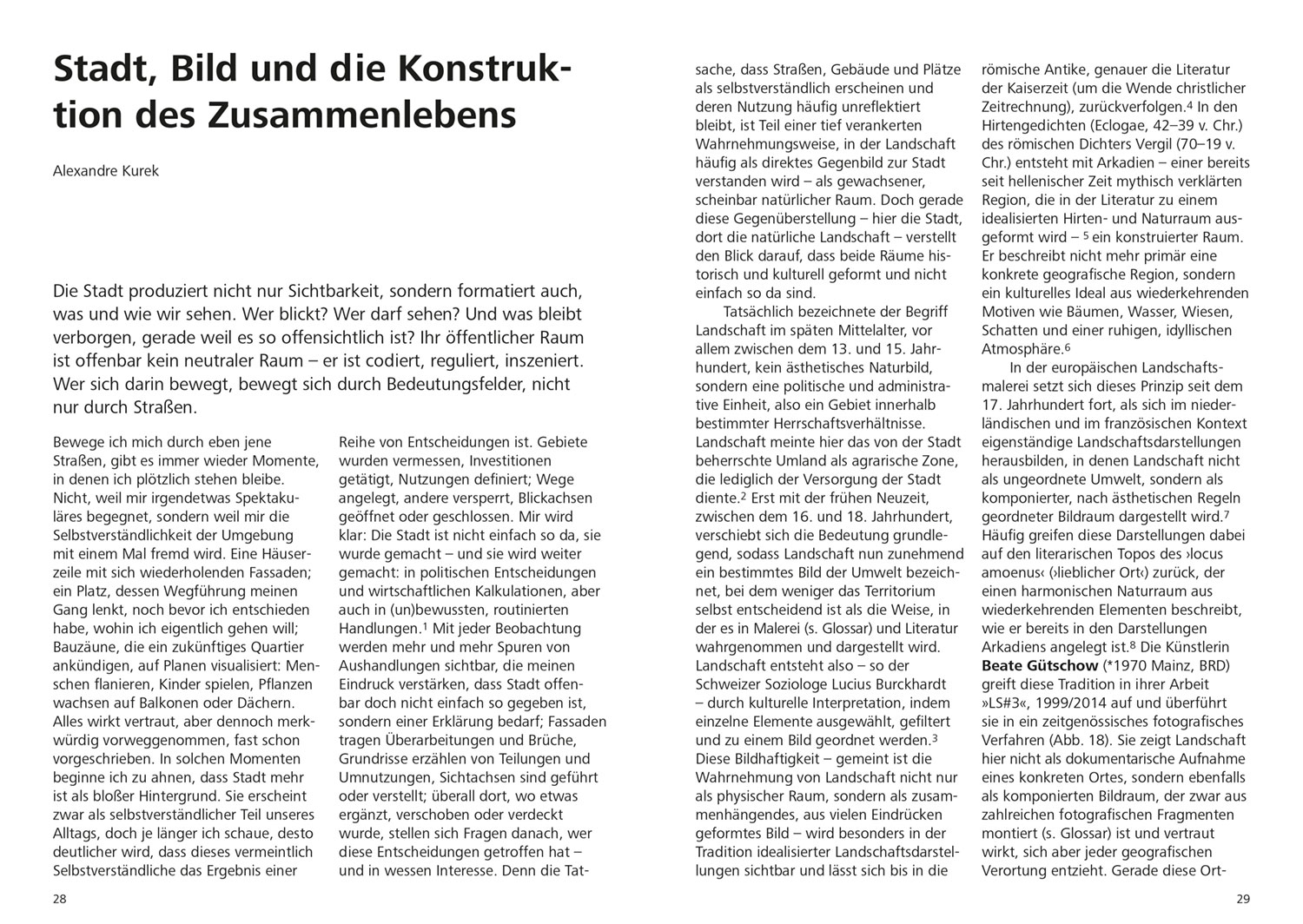
In European landscape painting, this principle continues from the seventeenth century onward, when independent forms of landscape representation emerge in Dutch and French contexts, in which landscape is depicted not as an unordered environment but as a composed pictorial space ordered according to aesthetic rules. [7] These representations often draw on the literary topos of the ›locus amoenus‹ (›pleasant place‹), which describes a harmonious natural setting composed of recurring elements, as already established in depictions of Arcadia. [8] The artist Beate Gütschow (*1970, Mainz, FRG) takes up this tradition in her work »LS#3«, 1999 and translates it into a contemporary photographic procedure (Fig. 18). Here, she does not present landscape as a documentary image of a specific place, but as a composed pictorial space that, although assembled from numerous photographic fragments and appearing familiar, eludes any geographical localization. Precisely this placelessness reveals that the depicted nature is not a real site but an image construction organized according to specific visual rules. [9] The apparent naturalness of her landscapes thus proves to be an effect of a cultural order established more than two thousand years ago.
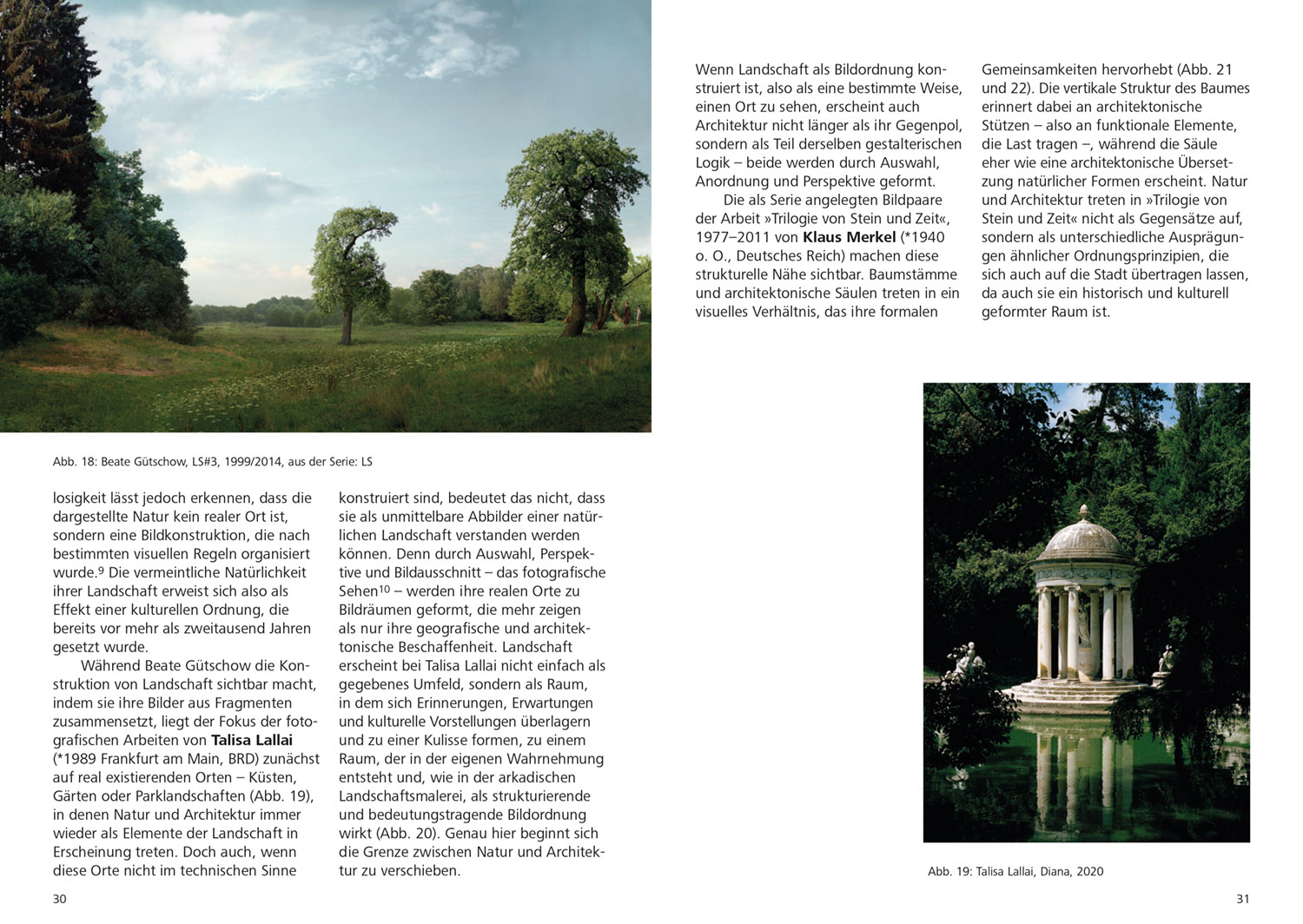
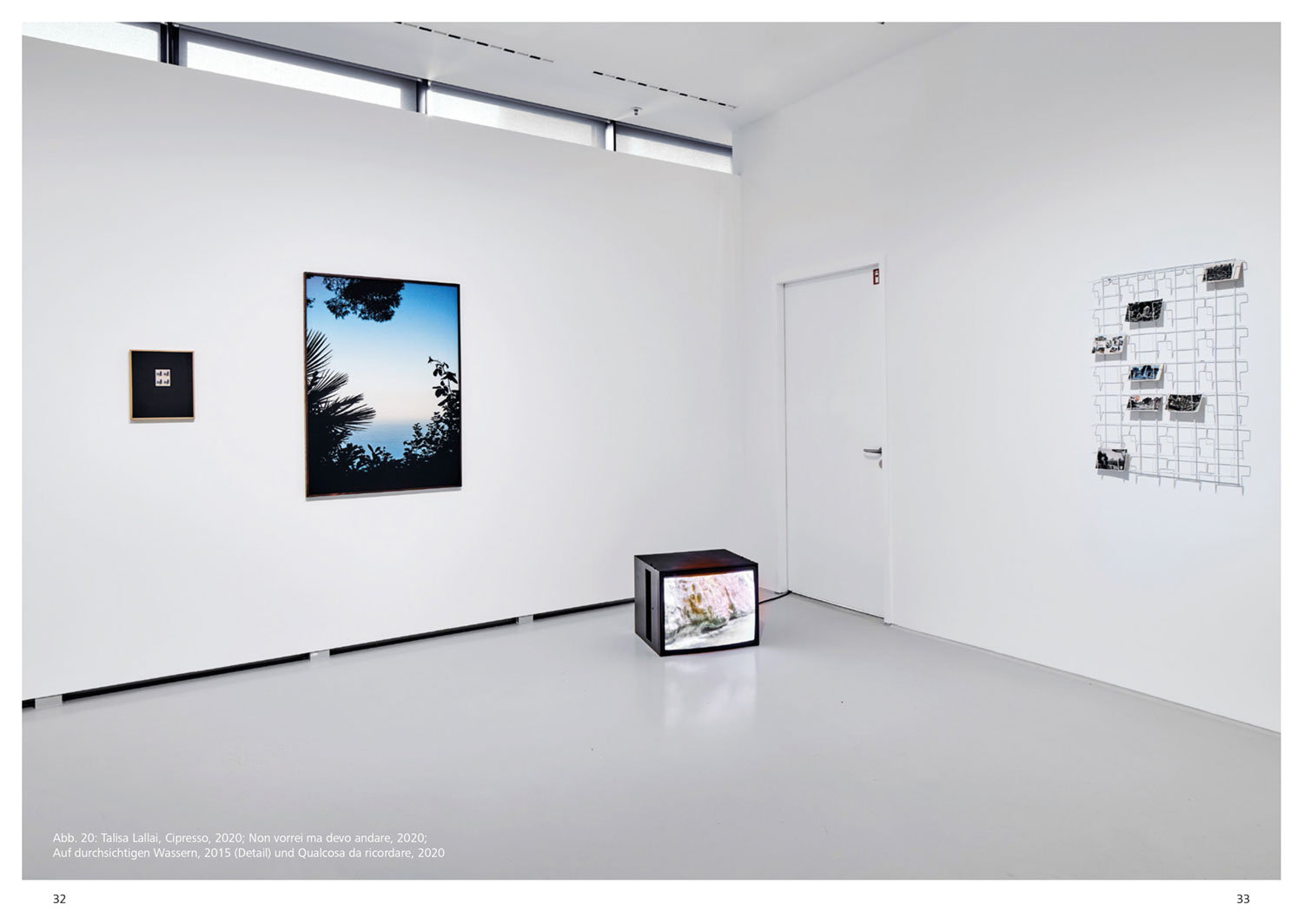
While Beate Gütschow makes the construction of landscape visible by assembling her images from fragments, the photographic works of Talisa Lallai (*1989, Frankfurt am Main, FRG) initially focus on real locations—coastlines, gardens, or parks (Fig. 19) in which nature and architecture repeatedly appear as elements of the landscape. Yet even if these places are not constructed in a technical sense, this does not mean that they can be understood as immediate representations of a natural landscape. Through selection, perspective, and framing—photographic seeing [10]—her real sites are shaped into pictorial spaces that show more than their geographical and architectural properties. Landscape in her work does not simply appear as a given environment but as a space in which memories, expectations, and cultural imaginaries overlap and form a kind of stage—a space that emerges within perception itself and, as in Arcadian landscape painting, operates as a structuring and meaning-bearing visual order (Fig. 20). It is precisely here that the boundary between nature and architecture begins to shift. If landscape is constructed as an image order, that is, as a particular way of seeing a place, architecture no longer appears as its opposite but as part of the same compositional logic—both are shaped through selection, arrangement, and perspective.
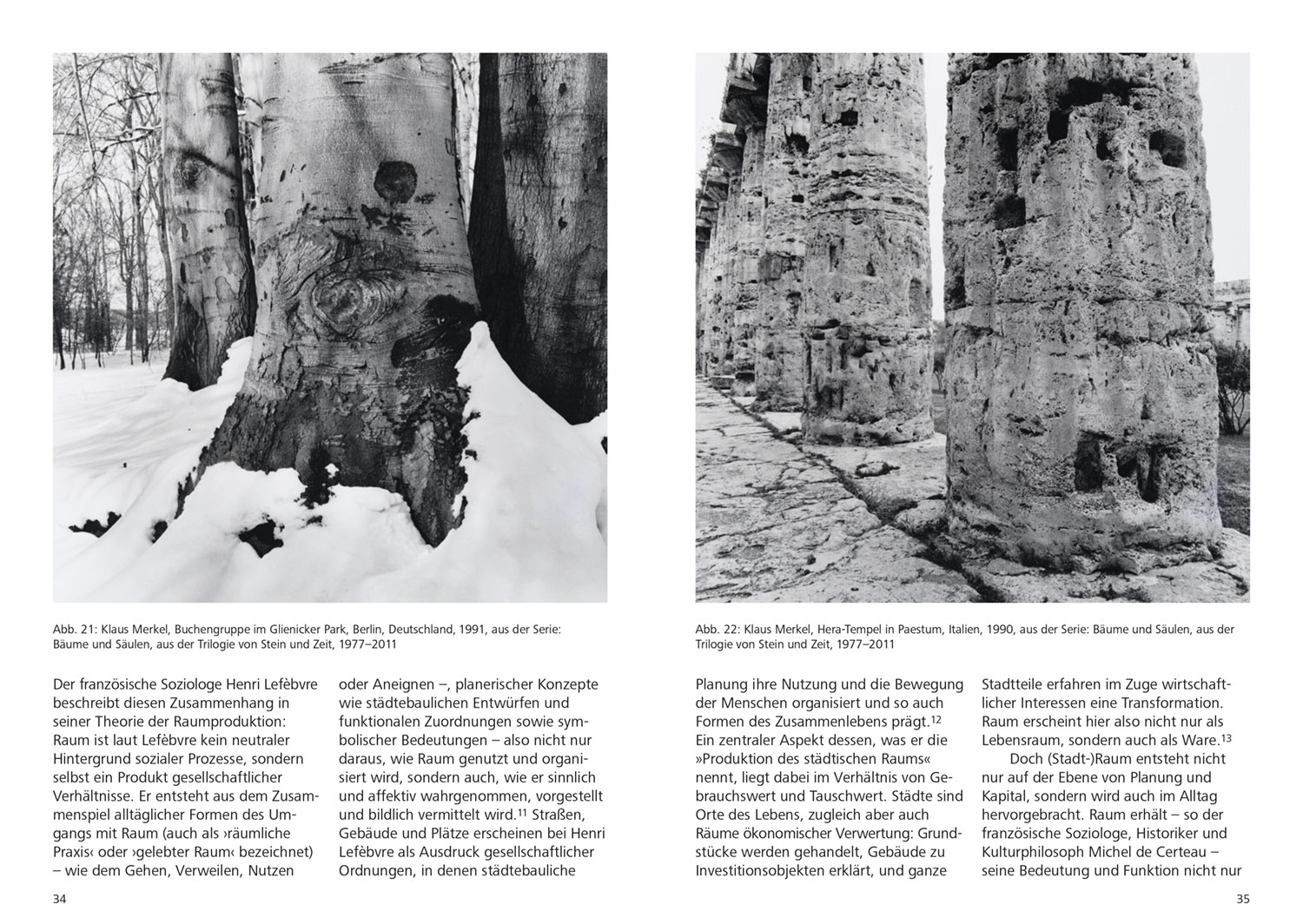
This structural proximity becomes visible in the paired image series »Trilogie von Stein und Zeit«, 1977–2011 by Klaus Merkel (*1940, place of birth unknown, German Reich). Tree trunks and architectural columns enter into a visual relation that highlights their formal similarities (Fig. 21 und 22). The vertical structure of the tree recalls architectural supports, while the column appears as an architectural translation of natural forms. Nature and architecture do not appear as opposites here, but as different manifestations of similar ordering principles, which can also be transferred to the city, as it too is a historically and culturally shaped space. The French sociologist Henri Lefebvre describes this connection in his theory of the production of space: space is not a neutral backdrop to social processes but itself a product of social relations. It emerges from the interplay of everyday forms of engaging with space – such as walking, dwelling, using, or appropriating—planning concepts such as urban designs and functional allocations, and symbolic meanings—that is, not only from how space is used and organized, but also from how it is sensorially and affectively perceived, imagined, and mediated through images. [11] Streets, buildings, and squares thus appear as expressions of social orders in which urban planning organizes their use and the movement of people, thereby shaping forms of coexistence. [12] A central aspect of what he calls the production of urban space lies in the relation between use value and exchange value. Cities are places of living, yet at the same time spaces of economic valorization: land is traded, buildings are turned into investment objects, and entire districts undergo transformation in the course of economic interests. Space thus appears not only as a living environment but also as a commodity. [13]
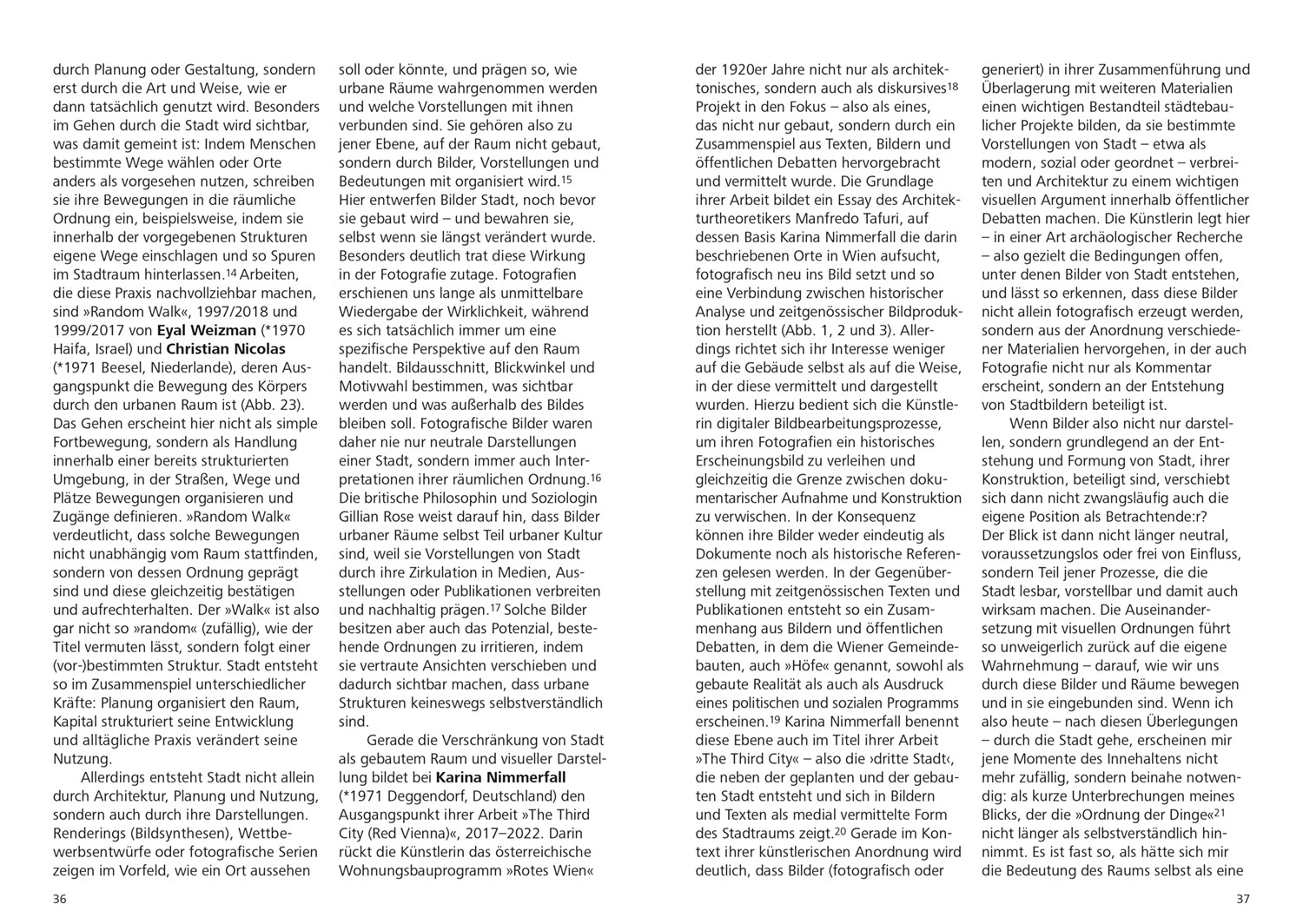
However, urban space is not produced only at the level of planning and capital; it is also generated in everyday life. Space acquires its meaning and function not only through planning or design, but through the ways in which it is actually used. This becomes particularly visible in walking through the city: by choosing certain paths or using places differently than intended, people inscribe their movements into spatial order. [14] A work that makes this practice tangible is »Random Walk«, 1997–1999 by Eyal Weizman (*1970, Haifa, Israel) and Christian Nicolas (*1971, Beesel, Netherlands), whose starting point is the movement of the body through urban space (Fig. 23). Walking does not appear here as simple locomotion but as an action within an already structured environment, in which streets, paths, and squares organize movement and define access. The »walk« is therefore not as »random« as the title suggests, but follows a structured logic. The city thus emerges through the interplay of different forces: planning organizes space, capital structures its development, and everyday practice transforms its use. Yet the city is not produced solely through architecture, planning, and use, but also through its representations. Renderings, competition designs, or photographic series show in advance what a place should or could look like, thereby shaping how urban spaces are perceived and what imaginaries are associated with them. They belong to that level at which space is not built, but organized through images, imaginaries, and meanings. [15] Here, images design the city before it is built—and preserve it even when it has long since changed. This becomes particularly evident in photography. Photographs have long appeared as immediate reproductions of reality, although they always represent a specific perspective on space. Framing, angle of view, and motif determine what becomes visible and what remains outside the image. Photographic images are therefore not neutral depictions of a city, but interpretations of its spatial order. [16] The British philosopher and sociologist Gillian Rose points out that images of urban spaces are themselves part of urban culture, because through their circulation in media, exhibitions, or publications they disseminate and shape imaginaries of the city. [17] At the same time, such images also hold the potential to unsettle existing orders by shifting familiar views and thereby revealing that urban structures are by no means self-evident.
This entanglement of the city as built space and as visual representation forms the starting point of Karina Nimmerfall’s (*1971, Deggendorf, Germany) work »The Third City (Red Vienna)«, 2017. In it, the artist brings the Austrian housing program »Red Vienna« of the 1920s into focus not only as an architectural but also as a discursive project— [18] that is, one produced not only through construction but through an interplay of texts, images, and public debates. The basis of her work is an essay by the architectural theorist Manfredo Tafuri, on which Nimmerfall retraces the sites described in Vienna, re-photographs them, and thus establishes a connection between historical analysis and contemporary image production (Fig. 1, 2 und 3). Her interest, however, lies less in the buildings themselves than in the ways in which they were mediated and represented. To this end, she employs digital image-processing techniques to give her photographs a historical appearance while at the same time blurring the boundary between documentary image and construction. As a consequence, her images can be read neither clearly as documents nor as historical references. In juxtaposition with contemporary texts and publications, a constellation emerges in which the Viennese housing complexes—the so-called »Höfe«—appear both as built reality and as expressions of a political and social program. [19] Karina Nimmerfall names this level already in the title of her work »The Third City«—the »third city« that arises alongside the planned and the built city and manifests itself in images and texts as a medially mediated form of urban space. [20]
If images are involved in the construction of the city, then one’s own position as a viewer also shifts. The gaze is no longer neutral, but part of the processes that render the city readable, imaginable, and thus effective. Engagement with visual orders thus leads back to one’s own perception – to how we move through these images and spaces and how we are implicated in them. If I now walk through the city after these reflections, those moments of pause no longer appear accidental, but almost necessary: as brief interruptions of my gaze, which no longer accepts the »order of things« as self-evident. [21] It is as if the meaning of space itself reveals itself gradually with every step—as a shift in what is considered given. The question »How do we want to live?« [22] thus no longer appears as something imposed from the outside, but as something that emerges from one’s own perception of the city: as the consequence of an irritation that occurs precisely where the apparent self-evidence of the built environment begins to fracture. Through this rupture, it gradually becomes apparent that what surrounds us is the result of decisions – decisions about how living, working, moving, and seeing are organized. The question »How do we want to live?« stems from the insight that spatial structures always also determine forms of coexistence, that paths, access, images, and uses guide everyday life while at the same time opening and limiting possibilities; yet we ourselves, through what we do in the city, how we perceive it, and which images we produce and circulate, are inevitably involved in its construction.
It is precisely here that the potential for change emerges. Once the city is understood as something made, it no longer appears fixed, but transformable, open to being rethought. This potential becomes visible where other images of the city come into play—images that do not merely confirm order and function, but also make visible ruptures, detours, or ambiguities. Urban spaces might then appear not only as efficiently organized infrastructures, but as places of lingering; not only as planned environments, but as open structures that allow different uses; not only as clearly defined functional entities, but as spaces that change through use. Images can prepare such shifts by making alternative forms of coexistence and engagement with the city imaginable. Could representations that point to a structural proximity between grown and built forms also allow architecture to be thought differently—not as a rigid construction, but as a process that follows other forms and materials, those not primarily oriented toward efficiency and standardization, but toward human beings and their environment? And could this not also lead to an awareness of modes of construction and materials that are conceived not only technically but also ecologically, or to an architecture in which the separation of nature and culture is understood not as an opposition, but as a relation?
The task of art, then, lies less in definitively explaining the city than in making visible those moments in which its apparent self-evidence begins to falter, thereby revealing the conditions under which it appears self-evident at all. I do not see in this a lack of clarity, but rather a shift: away from what is fixed, toward what becomes visible once we begin to look more closely. What then emerges—that the city is constructed rather than given – does not demand an immediate answer, but calls on us to take a position. And perhaps this is already where another way of thinking the city begins to take shape.
—
[1] Cf. Henri Lefebvre: »The Production of Urban Space«, 1975. In: Oliver Clemens et al. (eds.), Material on: Henri Lefebvre, The Production of Space, 2002, pp. 4–20, here pp. 4–6 [Link: last accessed: March 28, 2026].
[2] Cf. Lucius Burckhardt: Warum ist Landschaft schön? Die Spaziergangswissenschaft. Ed. by Markus Ritter and Martin Schmitz, Berlin 2006, p. 104, 114 f.
[3] Cf. ibid., pp. 19–21, 122.
[4] Cf. ibid., p. 21, 114.
[5] Cf. ibid., p. 114 f.; cf. Werner Busch: »Landschaftsmalerei«. In: Geschichte der klassischen Bildgattungen in Quellentexten und Kommentaren, vol. 3, Berlin 1997, p. 38 [Link: last accessed: March 28, 2026].
[6] Cf. Ernst Robert Curtius: Europäische Literatur und Lateinisches Mittelalter, Bern 1984, pp. 191–195 [Link: last accessed: March 28, 2026].
[7] Cf. Burckhardt, Warum ist Landschaft schön?, p. 116.
[8] Cf. Busch, »Landschaftsmalerei«, p. 38; cf. Curtius, »Europäische Literatur und Lateinisches Mittelalter«, p. 189 f., 192.
[9] Cf. Anna-Catharina Gebbers: »Larger than life«. In: Beate Gütschow: Z/I/S/LS, Heidelberg 2016, pp. 18–26.
[10] Cf. Gillian Rose: »Visual Culture, Photography and the Urban: An Interpretive Framework«. In: Space and Culture, India 2 (2014) 3, pp. 5 f. [Link: last accessed: March 28, 2026].
[11] Cf. Lefebvre, »The Production of Urban Space«, p. 4, 14–15.
[12] Cf. ibid., p. 24.
[13] Cf. ibid., pp. 14, 18 and 24.
[14] Cf. Marian Füssel: »Dead Places and Lived Spaces: On Michel de Certeau’s Theory of Space S. J.«. In: Historical Social Research 38 (2013) 3, pp. 22–39, here p. 30.
[15] Cf. Stuart Elden: »›There is a politics of space because space is political.‹ Henri Lefebvre and the production of space«, 1998. In: Clemens et al., Material on: Henri Lefebvre, Die Produktion des Raums, pp. 27–35, here p. 30 f. [Link: accessed: October 22, 2024].
[16] Cf. Rose, »Visual Culture, Photography and the Urban«, pp. 5–7.
[17] Cf. ibid., p. 5.
[18] The term ›discursive‹ refers to the French philosopher Michel Foucault and denotes that things are not simply given, but are produced through statements, images, and practices. Discourses determine what can be said, seen, and regarded as true, and often appear self-evident, although they are historically constituted.
[19] Cf. Austria Kultur International: »PHOTO IS:RAEL mit Karina Nimmerfall / Kulturforum Tel Aviv«, 2024. In: austriakulturinternational.at, 2024 [Link: last accessed: March 28, 2026].
[20] Cf. Karina Nimmerfall: »The Third City (Red Vienna)«, 2017. In: karinanimmerfall.com [Link: last accessed: March 28, 2026].
[21] The formulation refers to Michel Foucault’s book »Les mots et les choses. Une archéologie des sciences humaines«, Paris 1966 (German: »Die Ordnung der Dinge. Eine Archäologie der Humanwissenschaften«. Translated from the French by Ulrich Köppen, Frankfurt 1974), in which he argues that what we perceive as self-evident is based on historically constituted orders of knowledge that determine how things are ordered, seen, and understood.
[22] Referring to the title of the exhibition »Wie wollen wir leben?« by the Kunststiftung DZ BANK in Frankfurt am Main, June 3 to October 3, 2026.
Originally published in German; English translation by the author.
The Theodolite as a Dispositif
of Visibility and Control
Spatial politics, media technology, gaze
Essay
2026
Essay published in the exhibition catalog n+1. Mehr als ein Bild, issued by the Kunststiftung DZ BANK on the occasion of the exhibition of the same name in Frankfurt am Main (25 February–23 May 2026), developed in collaboration with Dr. Steffen Siegel. It examines Heba Y. Amin’s The Earth is an Imperfect Ellipsoid (2014–2020) and analyses the use of the theodolite as a media-technological dispositif of the production of visibility and control within the context of colonial cartography and photographic regimes of vision.
↘︎ Download the publication (DE)


»As the eye, such the object« [1], wrote the English poet and painter William Blake in 1808. By this he suggested that the perception of the world is never neutral or objective, but always dependent on the gaze, the perspective, or the consciousness of the observer; that what we see—the object—is invariably framed by our own concepts, sensations, and interpretations—our prior assumptions—and is viewed, classified, and evaluated from within that frame. Our gaze is therefore never indifferent; it is always bound to a specific position—both metaphorically and literally. It is precisely at this point that the artist Heba Y. Amin (*1980, Cairo, Egypt) intervenes with her work »The Earth is an Imperfect Ellipsoid« (2014–2020). Terms such as gaze, perspective, framing, and position constitute central elements of her inquiry into what it means to direct a camera at something or someone and to produce an image, and to stabilize that image through continuous circulation and repetition until it appears self-evident. She goes one step further, however, by questioning not only how certain bodies—particularly those of marginalized and vulnerable groups—are perceived, but also how they are mediated.
To this end, alongside the camera as a recording device, Heba Y. Amin employs another historically significant apparatus: the theodolite. This instrument, designed to measure horizontal and vertical angles, has existed in a narrower technical sense since the eighteenth century and continues to be used in both civil land surveying and military cartography. As a surveying instrument, it provides an essential basis for the drawing of borders and the determination of property—here especially in the context of colonial cartography, in which the visualization of land and bodies functions as a precondition of domination. Yet the theodolite cannot be described merely as a measuring device that generates quantifiable statistical data. It also constitutes a media technology that translates the gaze into a rule-based, calculable system, and at the same time a medial procedure of territorialization that does not simply represent spatial relations but produces them, rendering space itself an object brought forth through media operations.
The distinctive character of Heba Y. Amin’s images—a tightly cropped, circular frame that makes visible a spatial distance from the subject—results from her photographing through the telescope of the theodolite. This optical device can be understood, both in appearance and in function, as an allusion to the telescopic sight of a rifle—an association further reinforced by the occasional appearance of crosshairs in her images. The artist deliberately permits only a single perspective: that of distant observation, thereby compelling us as viewers to adopt a specific position in relation to what we see. In this way, she draws attention to the reproduction of a dominant mode of seeing within the nexus of knowledge and perception, while simultaneously organizing our gaze. By looking through this sight ourselves, we are required to reconsider our own views and assumptions and to reflect on the conditions that constitute them.
Heba Y. Amin’s use of the theodolite in combination with a camera can thus be understood as a reference to the hegemonic structures that shape vision as such—structures that determine what we look at, how we look, and why; in relation to »The Earth is an Imperfect Ellipsoid«: how we look at and perceive the Brown body [2]. Her work raises questions not only about what is represented and what is omitted, but also about how representation takes place and how it does not, thereby revealing one of the central characteristics of (media) images: they are first and foremost perspectival constructions that emerge within the relation between body (eye), apparatus (theodolite), and system (culture), and are therefore never neutral. The theodolite as a technical image-producing medium and photography as an imaging procedure function here as means of rendering visible both the (supposedly) Other, the foreign in the external world, and the Other, the foreign within ourselves.
—
[1] Quoted in Jonathan Crary: Techniques of the Observer. On Vision and Modernity in the Nineteenth Century, Cambridge, London 1992, p. 70 (cf. William Blake, »Annotation 10 Reynolds« [1808], in: Complete Writings, ed. by Geoffrey Keynes, Oxford 1972, p. 456).
[2] Analogous to the Black body, this term does not refer merely to a physical appearance, but to a system of socially constructed ascriptions, perceptions, and political implications.
Originally published in German; English translation by the author.
On the Art of Exploring a City
Reflection, urban perception, banalities
Essay
2025
On the Art of Exploring a City (2025) examines the relationship between the body, perception, and urban space through an autobiographical reflection on walking in the city. Using everyday movement through Berlin as a point of departure, it frames slow walking as a resistant practice that interrupts the logic of urban acceleration. Central to the text is the question of how pausing within the flow of the city can generate attention toward marginal, everyday phenomena. Photographic seeing is not treated as a technical act, but as a form of aesthetic and affective attention to the fleeting qualities of urban life.
↘︎ Download full text PDF (EN)
We move through streets every day, pressing forward with an urgency that feels self-imposed yet strangely absolute. Always moving, always navigating—hurrying from A to B as though the next place might finally offer relief. The city rewards this haste with noise and friction: the jostling bodies, the sharp edge of stress, the dull weight of exhaustion. In larger cities like Berlin, this rhythm becomes a way of life, a relentless pace that leaves little room for reflection. As we speed through urban canyons, dodging each other’s presence, we grow distant—not just from the streets and buildings around us, but from the selves we carry within.
I remember being ten years old, trailing my father during one of our family holidays. He had a habit of slowing down in places unfamiliar to us. »Walk slower,« he would say, »and you’ll notice the beauty of things.« I didn’t understand. I was restless, impatient to move on and see more. His advice, reasonable and true, sounded abstract, even ridiculous to a child eager to cram the world into fleeting moments. For years after, I kept rushing, though my reasons had shifted. It wasn’t curiosity anymore; it was something else—a compulsion to arrive, to finish, to move on. I was no longer seeing; I was merely passing through. It wasn’t until much later—at a random intersection in Berlin—that something in me faltered. Forced to stop by the red light and hemmed in by the flow of the city, I decided, almost without thinking, to take a breath. I looked around. A woman in a dress, its colors muted and graceful, stood across the street. Nearby, a man leaned against a corner shop, his entire outfit—down to the tablet in his hand—a study in lilac. A man walked two enormous dogs, their movements incongruously elegant. Smells drifted past: pizza, coffee, stale beer, cigarettes. The ordinary details of the street unfolded before me, not as obstacles but as offerings. The light changed, and I crossed, smiling faintly. What had just happened? Had the act of waiting, of doing nothing, opened some door?
As I continued walking, I noticed more: the interplay of shadow and light, the textures of walls, the angles where lines met unexpectedly. My father’s long- forgotten advice came back to me, and with it, a faint ache. He had stopped saying it after a while, perhaps resigned to my inability to understand. Yet here I was, two decades later, stumbling upon the truth of his words. The city, when you let it, teaches you how to see. The stroll, once a fixture of Sundays, has largely disappeared. It was, after all, a way of connecting—with family, with oneself, with the rhythm of a world that once seemingly moved slower. Writers, artists, and photographers knew this; their work often emerged from the quiet attentiveness of wandering. Henri Cartier-Bresson comes to mind, his lens drawn to fleeting, unposed moments. Yet in a time when slowness is met with suspicion, strolling has become an oddity. When people notice me walking slowly, phone in hand, they often stop and ask: What are you doing? Why here? Their questions, though tinged with unease, sometimes lead to warm exchanges. Occasionally, they lead to nothing. I’ve learned to welcome these moments. To pause at a red light is no longer just an act of compliance but an opportunity. The city, even in its most chaotic spaces, invites us to see. To slow down is to let the world seep in—to notice, to be changed by it. When I told my father about these small revelations, he smiled and said, »You see? That’s what I was trying to tell you all along.« His words stayed with me, quiet but insistent, like the light catching on glass at just the right angle.
There is something about moving too quickly that feels violent, even if the violence is subtle, it is a violence we inflict upon ourselves. In a place like Berlin, speed becomes second nature, an unspoken rule. The streets are structured for efficiency, not intimacy; their lines and flows seem to mock the idea of pausing. Yet within this relentless pace lies the tension of absence: the absence of the present, the absence of attention. We hurry forward, but toward what? Most of the time, we don’t even know. That day at the intersection felt like an interruption, but in retrospect, it was a gift. The waiting itself became a kind of seeing. Noticing the details—the lilac man, the woman in her dress, the mingling scents—was less about the objects themselves and more about the act of noticing. When I resumed my walk, the city unfolded differently. The way the sunlight hit a broken beer bottle and refracted into something momentarily beautiful. The way the cracks in the pavement formed patterns I had never thought to trace. These moments were small, fleeting, almost imperceptible, but they were also profound. I began to understand what my father had tried to teach me: that attention itself is a kind of love, and love—directed at the world, at the unnoticed—has the power to transform.
These days, I walk slowly, more slowly than most people find comfortable. My pace unsettles some; I see it in their sideways glances. When they stop to ask what I’m doing, I explain in as few words as possible. »I’m looking,« I say. Most don’t understand. A few do. Occasionally, these encounters lead to conversations or even a shared walk. More often, they lead to nothing. But that’s okay. I don’t walk to be understood; I walk to understand.
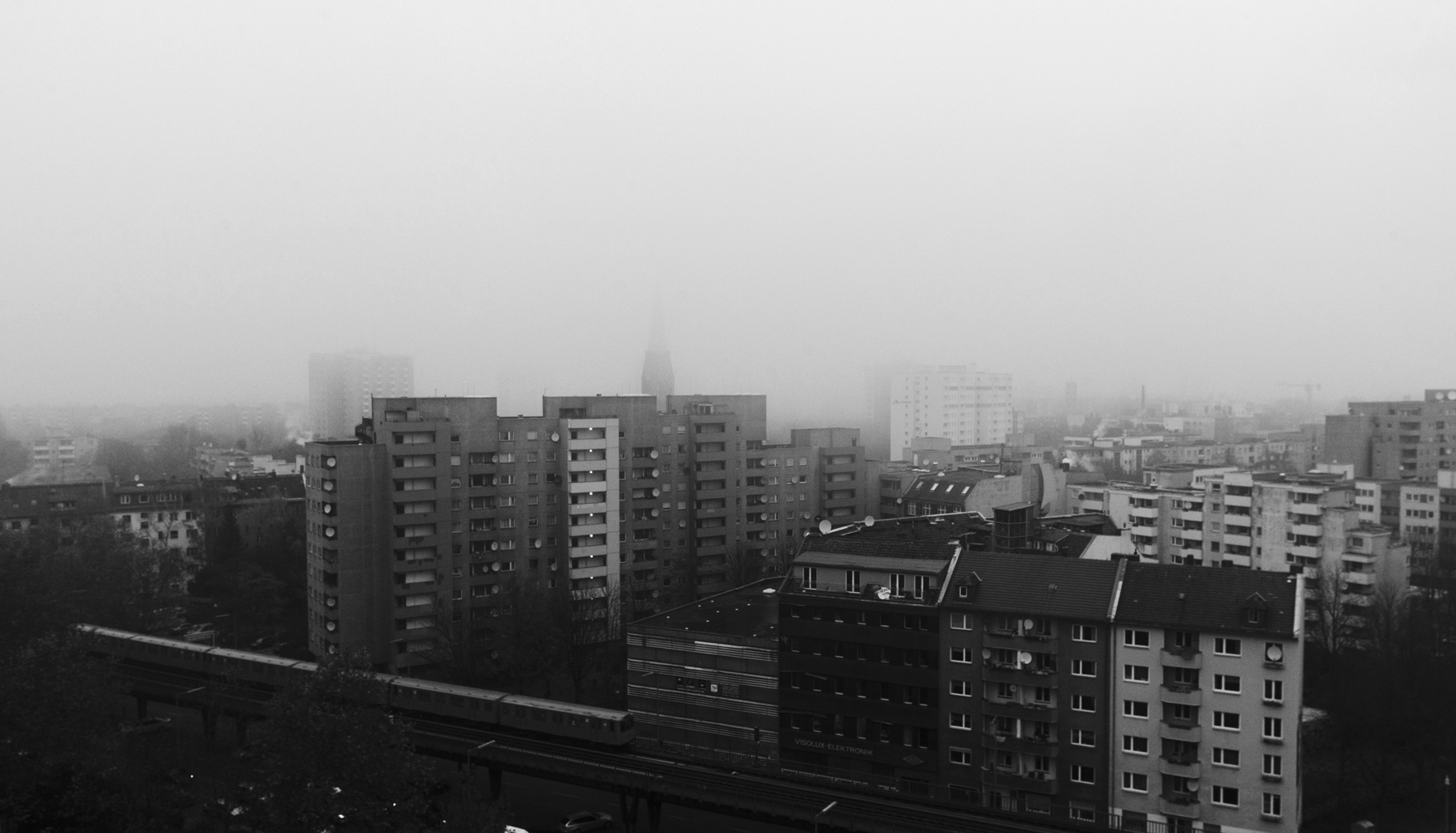
Image: Alexandre Kurek, Berlin Kreuzberg, Germany 2017.
Trapped in the Dream of the Other
Video art, ecology, infrastructure
Essay
2023
This text formed the basis of a presentation for the seminar Technolandschaften, taught by Prof. Dr. Birgit Schneider in the European Media Studies (EMW) programme at the University of Potsdam and the University of Applied Sciences Potsdam. It focuses on Revital Cohen and Tuur Van Balen's Trapped in the Dream of the Other (2017), shown in the exhibition Image Ecology at C/O Berlin.

Trapped in the Dream of the Other (2017) by Revital Cohen (Israel) and Tuur Van Balen (Belgium) is a performance presented as a video work (or, more precisely, the video documentation of a performance) that examines the supply chains of global capitalist consumption and the ongoing colonial exploitation of resources and labour in the Democratic Republic of the Congo. [1] The video is presented within the chapter »Labour« as part of the group exhibition Image Ecology, on view at C/O Berlin from 16 September 2023 to 18 January 2024 and curated by Boaz Levin (guest curator) and Dr Kathrin Schönegg. [2]
Trapped in the Dream of the Other was filmed in 2016 at a mining site in the Democratic Republic of the Congo, more specifically in the town of Numbi, in the eastern border region of the DRC near Rwanda. Among the minerals extracted from the mine are coltan, cassiterite, gold and tungsten: Coltan is used in the production of virtually all electronic devices, including laptops, smartphones, digital cameras, game consoles and electric vehicles. Cassiterite is economically the most important ore for the extraction of tin and is used in the production of tinplate and various chemical products (alongside China, the United States, Japan and Germany are among the world's largest consumers of tin). Tungsten is used, among other things, in the production of cemented carbide and can be found not only in light bulbs, fluorescent lamps and, in its molten state, electrical contacts, but also in armour-piercing ammunition used by the American M1 Abrams and the German Leopard II main battle tank.
The 100 kilograms of fireworks detonated during the performance were specially commissioned and imported from Liuyang in China's Hunan Province—the centre of the country's fireworks industry. To make this possible, Cohen and Van Balen had to establish an entirely new trade route, as no infrastructure for importing fireworks into the region existed. The crates were shipped by container vessel from China to South Africa, flown from there via Ethiopia to Rwanda, and finally transported across the Rwandan border into the Democratic Republic of the Congo. As the artists remark: »Shipping ammunition might have been easier.« [3] The import of Chinese fireworks returns to the subject of global resource and production cycles. For several decades, China has expanded its presence across the African continent, particularly in the resource-rich Democratic Republic of the Congo, extracting raw materials that are subsequently processed domestically or supplied to the global commodities market. With their work, Cohen and Van Balen complete this cycle of extraction, production and circulation.
Trapped in the Dream of the Other is a performance because the artists have embedded a series of actions that extend the work far beyond what we, as viewers, are able to perceive audiovisually. Some of these actions are visible and audible—for example, the exploding fireworks or the connection tone of a smartphone—while others remain invisible.
We see a lush green landscape stretching across the horizon—the Congolese rainforest. The foreground is marked by exposed rock and dozens of shafts blasted into the stone—deep, open and narrow—running like arteries through the barren terrain. We hear and see a series of smaller explosions, plumes of coloured smoke, and people (predominantly men, Black bodies) who remain mostly in the background, though occasionally moving into the foreground. They shout in a language that remains unintelligible to us while, equipped with only the most rudimentary tools and dressed in T-shirts, jeans and rubber boots, they dig for minerals and carry them away in sacks over their shoulders. The scene is filmed with a wide-angle lens. The field of view is expanded, the edges of the frame distorted—we are under the impression of standing within this surreal landscape ourselves. We hear the connection tone of a smartphone just before another explosion occurs; smoke rises once again, while people continue working in the background—kneeling, digging.
What we do not see is that, while the person operating the camera is physically present at the mine in eastern Democratic Republic of the Congo, the other person is located in East London, and the two communicate through a network—hence the audible smartphone connection tone. This network is made possible through the use of devices whose production depends on the extraction of the very resources being mined in the film: conflict minerals. We do not see how the raw materials required for the production of the fireworks were extracted beforehand. We do not see how the finished fireworks were transported and installed on site. We do not see who is filming and who is receiving the transmission. Who, then—as the title of the work suggests —is trapped in whose dream?
Trapped in the Dream of the Other draws attention to a compelling aspect of contemporary production: the simultaneous visibility and invisibility of modern electronic devices—our smartphones, laptops and televisions, the so-called black boxes. We do not see the extraction of the raw materials required for their manufacture or the effects of this extraction on landscapes and the people who work within them. Nor do we see the infrastructure behind these devices—where things come from, where they go, and who makes all of this possible. What we see is only the finished product.
—
[1] Cf. Revital Cohen, Tuur Van Balen: »Trapped in the Dream of the Other« (n.d.). In: cohenvanbalen.com [Link: last accessed: August 3, 2026].
[2] Cf. C/O Berlin Foundation (ed.): »Image Ecology. Press Kit«. In: co-berlin.org, Berlin, 2023 [Link: last accessed: August 3, 2026].
[3] Revital Cohen, Tuur Van Balen: »Trapped in the Dream of the Other« (n.d.). In: cohenvanbalen.com [Link: last accessed: August 3, 2026].
Image: Revital Cohen, Tuur Van Balen, Trapped in the Dream of the Other, 2017, video still. © Revital Cohen, Tuur Van Balen.
The City
Reflection, urban perception, banalities
Essay
2021
The City (2021) conceptualizes the modern city not as a static built environment but as a living organism embedded in a continuous and reciprocal relationship with its inhabitants. The city is understood as a form of collective memory—absorbing, structuring, and reflecting the traces, narratives, and emotions of those who move through it. In this relational perspective, urban space is never neutral; it is shaped by social practices and sustained through both individual and shared imaginaries. Urban experience is framed as a performative process in which identities, spatial configurations, and narrative structures are continuously co-produced. Responsibility for the city’s future lies in the present—specifically in the actions of its inhabitants, whose everyday practices continually influence the city's visual, social, and emotional fabric.
↘︎ Download full text PDF (EN)
The modern city, as we know it, is indeed a gigantic man-made structure, yet on a deeper level, it remains an organic one—a living and breathing creature, if you will; it either grows and flourishes, or it withers and dies, depending on how we, its inhabitants, nurture or neglect it.
I perceive the city as a living organism, a collector, telling the stories of its people—their history, achievements, ideology, and fears—always aspiring to have its own unique character whilst constantly demanding our attention. The city never forgets; it absorbs, internalizes, and reflects the behavior of each of us. Every single person that wanders in it—whether a visitor or a resident—leaves their footprints, little pieces of their personality, traces of their existence. We provide the substance that sustains it, and the city is a passionate gatherer. It truly loves our stories; around every corner, behind each façade and through every window, in every second of the day or the night, life unfolds in its purest form, and the city delightfully experiences all of it—yet remains a trustworthy listener and stays concealed, never revealing its secrets. You can expect it to keep your secrets—unless you want your stories to be told, in which case the city serves as a blank canvas, waiting for you to leave your mark. It almost dares you to claim even the smallest corner, to carve yourself into its ever-changing fabric. So go ahead—wander around and leave your marks for others to discover. The city will embrace your gift with gratitude.
For those who dare, the city can turn into a dream fulfilled—as they see it as something inspiring, emotional, and surprising—providing them with nearly limitless possibilities for self-expression and growth, allowing them to live a prosperous life. For those who don’t, the city might transform into a cold, indifferent labyrinth of concrete and glass, overwhelming them with its rationality, leaving them trapped in a suffocating, anxious existence. Though the city itself is never truly menacing but merely a mirror of our own inner selves—a reflection of our soul, if you will—it can strike us with the utmost severity at any given time if we feel threatened by it. The city needs to adapt to us as much as we need to adapt to our city. It yearns to become an integral part of our lives, and in the same way that we all are a vital part of what defines it, the city is inevitably a vital part of what defines us. We live in a close relationship with our city—a synthesis; we nurture and shape the city, and in return, it allows us to do the same. We—each and every individual roaming its streets—collectively shape our city, thus providing it with a unique visual identity and making it what it is today: whether a benevolent mother, in whose embrace we find safety, or a relentless, all-devouring behemoth.
We all bear responsibility for our actions, for it is our deeds today that will shape the city of tomorrow. It's up to us to make our city more diverse, more special, and therefore, more desirable; to define whether it is a blessing or a curse. It's up to us to create a city in which we all want to live. So let’s create—and always keep in mind: all cities are beautiful.
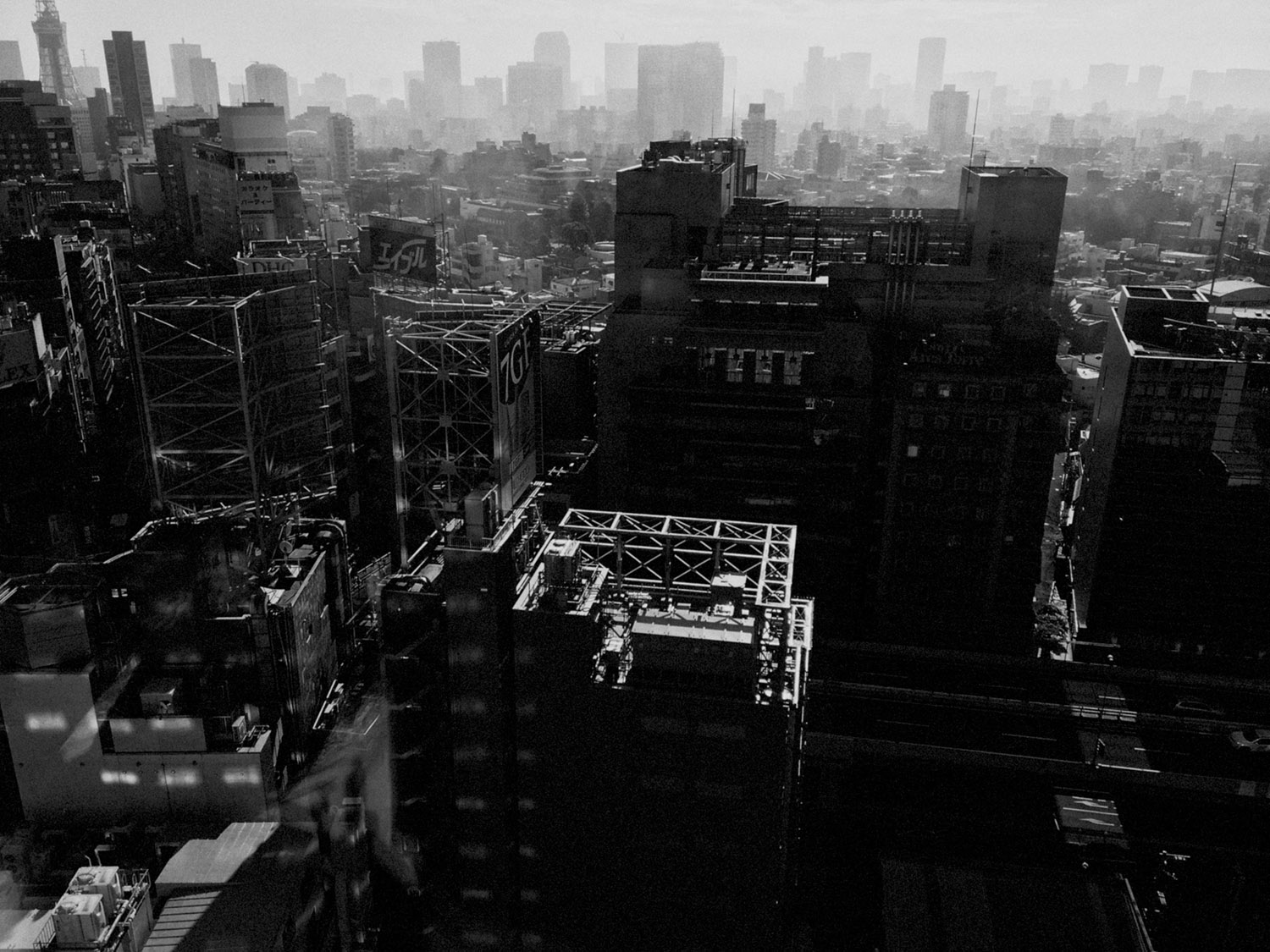
Image: Alexandre Kurek, View from Hotel, Tokyo, Japan 2020.
A Rainy Day in Marrakech
Reflection, urban perception, banalities
Essay
2021
A Rainy Day in Marrakech (2021) reflects on a moment in Marrakech (Morocco) that challenges dominant visual and narrative representations of the city shaped by tourism and media. Contrasting the usual imagery of vibrant markets and picturesque scenes, the account foregrounds a melancholic, rain-soaked urban atmosphere that reveals aspects of everyday life typically excluded from the tourist gaze. Through observational description and photographic reflection, the city is portrayed as a layered reality marked by absence, boredom, routine—and sudden tragedy. The narrative emphasizes the disparity between curated public images and the mundane, often invisible dimensions of urban experience.
↘︎ Download full text PDF (EN)

It was almost as if the rain had washed away any traces of an identity we—the tourists, travelers, photographers, writers—had given to Marrakech over the years, and had now revealed a much truer reflection of a city usually depicted as far more colorful and exciting than it truly is. But not on that day. Gone were the beautiful, rich colors and the smells of various spices and freshly cooked foods, typically experienced in Marrakech. Instead, I was witness to a grey and flavorless, almost melancholic truth of the so-called Red City—unveiling a deeper drama of mundane life right before me, capturing my deepest attention. Wandering through almost deserted streets, I caught a glimpse of a reality hidden from most of the foreign visitors—a reality filled with boredom and futility. There was no need for artificial excitement, for there were simply no tourists present who had to be artificially kept excited. The only people present, aside from a few stray visitors like myself, were Moroccans going about their business or seeking shelter from the rain under canopies, in shops, or doorways, minding their own lives.
I met Nick at Café de France later that day. After being separated for a few hours—we decided to go our separate ways for a while to focus on taking photographs without distracting each other—we sat down to have a coffee and talk on the roofed balcony, just minutes before a heavy rainstorm hit. As those seated in the front row of the balcony fled from the fierce rain, Nick and I—seated safely in the back row—were rewarded with an excellent view of the usually crowded Jemaa El Fna square. We watched in awe as the storm grew stronger, with lightning strikes illuminating the sky, while people across the square frantically ran, seeking shelter. The sky cleared, and the storm ended just as abruptly as it had started, as we continued our journey through Marrakech together. Drawn to a crowd of people gathered in front of a large but inconspicuous building next to the Maison de la Photographie—which we had just visited—we decided to stay and observe the scene for a little while. It quickly became clear that the building was, in fact, an elementary school about to end its classes, and soon the people in front of it were greeted by dozens of children rushing out, screaming, chanting, and laughing—young lives invigorating the lifeless streets once again.
Stepping back to an opposite wall while joyfully watching the children embrace their loving parents, I looked around and noticed five or six men approaching quickly, carrying a gurney loaded with something unidentifiable, covered only by a white sheet. Seemingly unnoticed by the parents—too caught up in the excitement—the men slowed down, shouting as they pushed their way through the crowd. Catching a glimpse of what lay hidden beneath the sheet, I realized they were carrying the dead body of a young boy, carrying him as fast as they could through the narrow streets of Marrakech to whatever their final destination was. A man standing next to me—one of the very few who had noticed the scene—quietly told me in French that he had heard about the recent tragedy of a young boy struck by a speeding car, not far from the very school where he and other parents had been standing, eagerly awaiting their children. »Il est mort,« he said in a subdued voice, certain of the boy’s fate. »They're rushing him to a nearby hospital, but it's already too late. He's dead. It happens a lot around here. People get hit by cars almost every day. It's horrible. You just can't be careful enough,« he continued, shortly before embracing his own son and disappearing around the corner, his hand tightly pressed around his son's.
Pictures of Marrakech—and Morocco in general—often show us only the sunny days, the vibrant markets, the delicious food, the carefully curated tourist attractions in the Medina, the architecture, smiling elderly people, cats, and donkeys, and all manner of colorful, playful scenes, as captured in some of my other images. But a beautiful color palette doesn’t matter if there is no light illuminate it. I guess, in a way, that was the reason why I chose to photograph mostly in black and white that day—so Marrakech, the Red City, could remain grey and sunless for a day, mourning the loss of yet another son.
»We like to pretend that what is public is what the real world is all about,« as Saul Leiter once said. But the truth is, there is always another world hidden beneath what is obvious and purposely displayed—a world not often photographed or recreated countless times before due to its mundane and unspectacular nature. But it is not sensationalism that drives me or that I seek in my photographs. It is the ordinary lives of ordinary people that interest me. On that day—while aimlessly roaming through Marrakech at first—I somehow managed to catch a glimpse of the very reality I seek, and I am deeply grateful to have experienced it.
Image: Alexandre Kurek, Marrakech, Morocco 2016.
Between Weight and Gesture
Reflection, media practice, visual culture
Essay
2020
Between Weight and Gesture reflects (2020) on the shift from conventional camera use to smartphone photography. Based on a personal experience while traveling in Morocco, it shows how the smartphone, as a photographic medium, alters not only the act of taking pictures but also perception and social dynamics in public space. Central to the text is the question of how technology shapes not only the production of images but also visibility, access, and agency within urban contexts. The essay is based on a reflection following the journey through Morocco and a related interview with Anne Schellhase, published in fotoMagazin (2017).
↘︎ Download full text PDF (EN, DE)

Why did I start taking photos with my phone? The most honest—and at the same time the most imprecise—answer would be: out of laziness. Although this term—too often morally overloaded—points less to inertia than to a form of pragmatic efficiency, to a desire to detach the photographic act from the weight of technical apparatus, from their symbolism and visibility.
For a long time, this weight was part of my practice, of my posture (in the figurative and literal sense). Anyone travelling with a camera, lenses, film rolls, memory cards and a hard drive does not engage in casual image-making but marks themselves—for others as well as for themselves—as someone who means what they do. This kind of visibility, through which the photographer inscribes themselves into public space, was not unpleasant to me; it lent a certain gravity to being on the move, a self-imposed obligation to pay attention. And yet, this relationship began to shift during a journey through Morocco—not abruptly, but casually, almost as a side effect. It was a moment during the ride from the airport in Fès into the medina when, for the first time, I didn’t reach for the camera but pulled out the smartphone from my jacket pocket. The setting sun above flat rooftops, the unfolding relief of the Atlas Mountains, people at the roadside—fleeting impressions I recorded without positioning myself. Not prepared, not in photographer mode, just simply: there. Photographing became a reaction to what was seen, not a staging or framing of it. When I looked through the images later, I was surprised by how much they retained: not just subjects, but a rhythm, a movement, a relation to the situation.
In the days that followed, I first left the camera in the backpack, then in the room. I continued to photograph—frequently, attentively, but inconspicuously. What changed was not just the device, but the relation to space. People responded to me differently. I was no longer marked as a photographer—not as a potential intruder, chronicler or observer, but simply as a person present. It became easier to make contact or to remain unnoticed. The phone, already ubiquitous, doesn’t attract attention—it evades it. The gesture of photographing with a phone is less an action than a movement, embedded in the flow of everyday life. This brought a question to the foreground, one that goes beyond technical or aesthetic considerations: To what extent does the medium with which we photograph shape not only the image, but also our position in the social realm—our relation to the environment, to visibility? With the phone, I was able to move more freely through urban space, to cross thresholds without being perceived as someone who wants something. The camera signals intention; the phone allows a relation of observation without intervention.
From Fès to Marrakesh to Essaouira, through alleyways, squares, souks and harbours, this experience continued. I observed, recorded, responded—not from the distance of a technical device, but from the proximity of a light, inconspicuous gesture. It wasn’t about devaluing the camera or celebrating the smartphone, but about the question of how media practices inscribe themselves into social practices. Taking photos with the phone became a form of movement, a method of perception—and a technique that does not operate through technical superiority, but through situational adaptation. I haven’t stopped working with the camera. It remains part of my professional and artistic repertoire. But what I found unintentionally was a solution to a familiar problem: How can photographic work happen in a way that doesn’t stand out through technology, but functions through attentiveness? Perhaps this marks a small shift: away from the image as object, towards photography as relation.
Image: Anja Rausch, Berlin, Germany 2025.
Lola Randl
Rural life, domestic space, place-making
Feature
2014
Co-authored feature published in THE WEEKENDER, Issue 15 (2014), on filmmaker and author Lola Randl's life and work in the Uckermark, a rural region in northeastern Germany. The text addresses rural life, domestic space, and the adaptive reuse of architecture as practices of place-making.
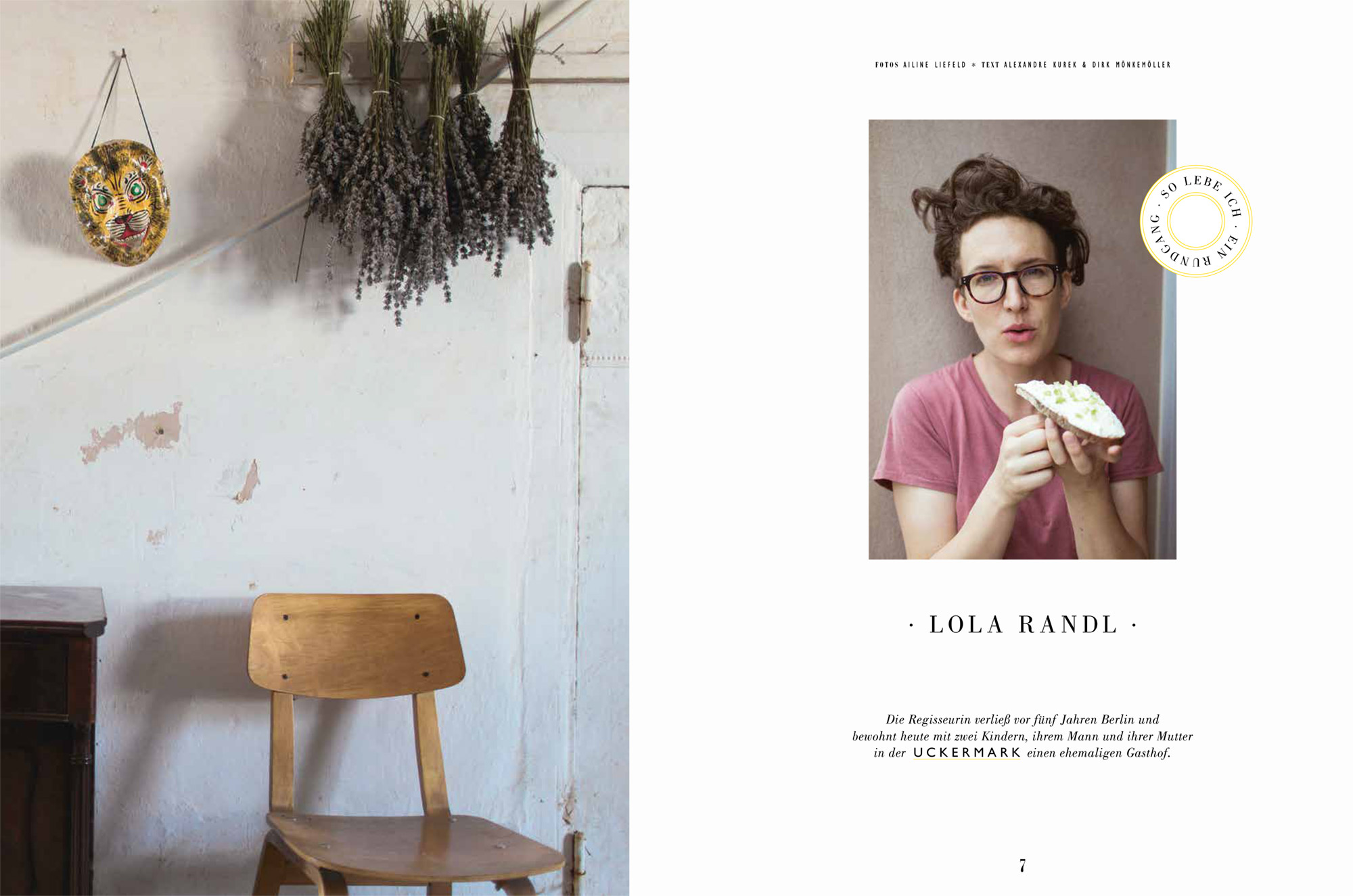
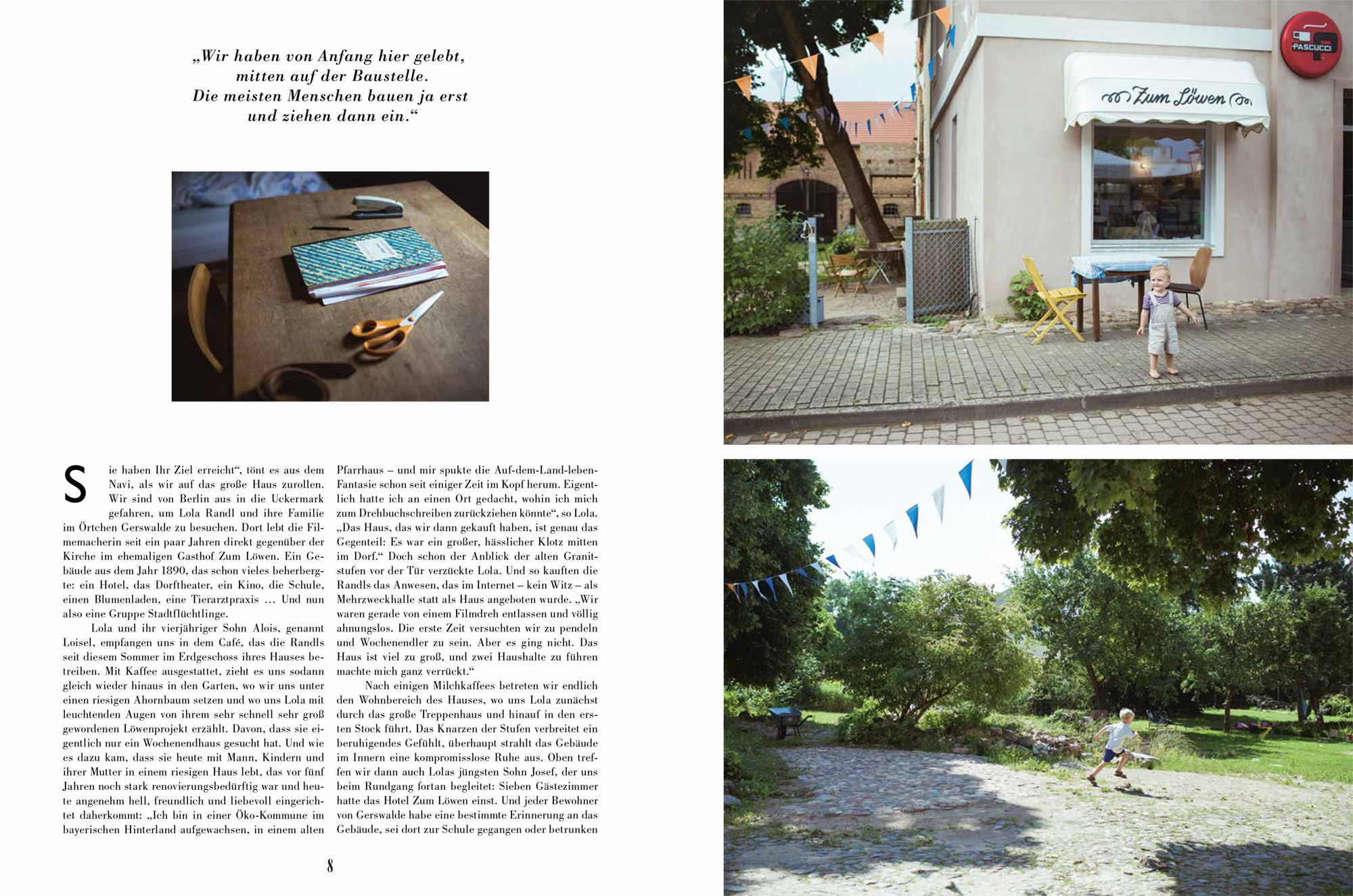

Images: Ailine Liefeld, Germany 2014.
Back to top